

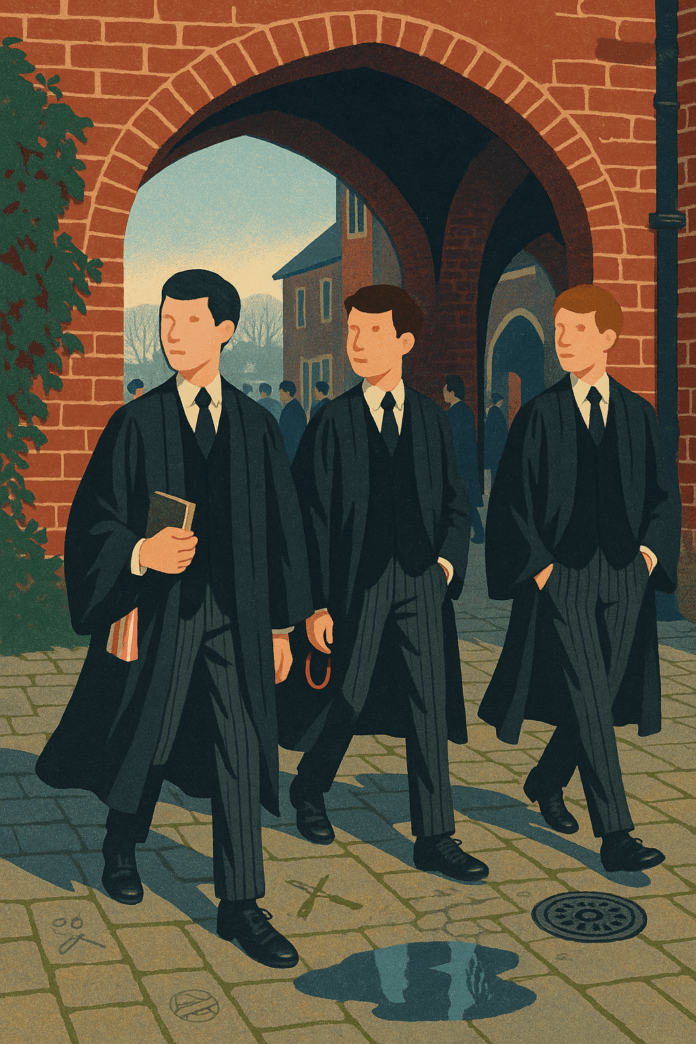
There’s no doubt that the possibility of enrolment in what is generally considered to be the world’s most renowned public school should be regarded as a significant privilege in life, whatever career dreams for a young boy may or may not have prevailed in his family prior to entry. Operating under the rules of Victorian discipline and fixated Anglo-Saxon customs dating from the Age of Reason, over two centuries ago major influences of Etonian ideology extended their grasp to the farthest corners of the globe and helped shape a unity of Empire and, indeed, a global heritage with Commonwealth roots, second to none.
They still do. Something about the manner in which students there are trained to think succeeds in perpetuating its political appeal to an enfranchised public. The result is that an overwhelming proportion of Britain’s leading administrators over the last two centuries were schooled in the jumbled housing that rises from the shadows of Windsor Castle’s ramparts. Whatever recognisable formulae may have emerged from an understandable pride in repeatedly successful procedures, the result has been an imposition of layers of moral justice that have triumphantly preserved a significant proportion of the modern world—clothed, over the past century, in its latest, venomous, clinking bottles—from mercilessly reverting to the horrors of ancient civilisations.
Had Eton College been a product owing homage to the Kaiser, or the Red Revolution, competitive nations might have restricted their confrontations to aggressive episodes of the Wall Game, with young lives put to better use than as a host of fallen bridges over strands of barbed wire. Instead, while hostile prejudices grew, officers from both series of opponents dissolved like snow on a warm morning and the rank-and-file blamed them for their own grief.
Eton College is no deliberate breeding ground for special sacrifice. As students, Spartan habits are discouraged. Timetables are sensible; food unremarkable but sufficient in both style and content. Meals are regular and consistent. Besides, there is the tuck shop.
As an alumnus makes his way from the school buildings down Eton High Street, the first establishment he will skirt is a sprawling cafeteria called Rowlands. This was our den of iniquity. With a withdrawal of pocket money taken from our house Dame, Miss Byron, in the early stages of our debutante years—before it could blow our carefully developed cool—we could indulge ourselves with supplements of British breakfast dishes and cold desserts, while temporarily lost in the adventures of Biffo the Bear and others, in periodicals left on tables for our entertainment as we ate.
The school system dictated that, upon arrival back at your residential building at the beginning of a new term, each student opened a cash account with the matron-administrator of their house—known as their Dame—and withdrew appropriate sums for personal use, according to credit available and under the Dame’s controlled conditions. This indulged the individual schoolboy with an element of freedom of choice, always a welcome relief from restrictive adversity stemming from conditions replete with oppression.
The division of the pupil population into a number of residential sub-divisions, that were physically and geographically accurate as plain fact, additionally served to structure competitive rivalries between them, supplying reasons to exercise while competing at team level.
During the Michaelmas term—from summer till Christmas—we played a league comprised of all houses in a game that combined soccer and rugby, specific to the school and known simply as the Field Game. For the subsequent period of Lent we were divided into those who ran with the ball at their feet and those who merely ran with the misshapen ball. Therefore, time in the year to form a school soccer team of remark was quite limited. As a solid aficionado of the former sport, from the club games I had attended while growing up in the capital, and the televised internationals that had begun to appear in your front room as this newest form of media increased its periods of transmission, I had always considered this a great shame—especially since Eton College had been instrumental in the original formation of both national league and cup football competitions against opponents from various walks of life across England. Spectating at a school team match against rival public schools or amateur enthusiast associations, I realised Eton no longer competed against professionals, but it was clear that the potential skill was available to us, had it been represented or supplemented by tactical training considerations. One teacher-referee once threatened me with a place in the school junior team, on the left wing, after a match where I notched two goals and an assist in our 3–2 victory over our immediate neighbours; but evidently his mention of me in despatches never reached the C-in-C’s desk, more’s the pity.
The summer term saw a different division, this time between oarsmen and cricketers, known at the school as wet bob sand dry bobs. Rowing was perhaps the hardest discipline on offer at Eton, until becoming a graduate of River Thames procedures allowed the individual boy the use of a pencil-thin craft known as a rigger, whose lightness and manoeuvrability released the oarsman into stretches of water previously unavailable within the time limits permitted by absence from academia.
These boats would be rented from the school to cover the complete term in a single payment, and were stored in a boathouse adjacent to Windsor Bridge, in ideal conditions of care and maintenance.
Unless comprised of nothing but cricketers, each schoolhouse had rowing teams of four, plus a coxswain to sit in the stern and steer a five-man boat—a task I was soon allotted owing to my, as yet, under-developed dimensions.
Then, teaming up to cox two colleagues in a number of races—rowed in clinkered barges in rivalry between the twenty-five or so competing-house wet-bobs—I succeeded in steering dearest Rudolph d’Erlanger and Robin Hartley to overall victory as the finest junior oarsmen in the College, and we three were awarded ancient silver-pot trophies for our trouble. In the summer term of my last two years I coxed to victory, both times, one of the two eights composed of athletes who had missed the cut when it came to Eton’s number-one competitive line-up.
Finally producing blood from stones, those who must decide issued me with the basic pink-striped titfer corresponding to sporting success on the river, in recognition. I remained highly underwhelmed.
The section of river running downstream from Henley to Windsor and beyond offered a playground to Etonian oarsmen of repute. Four miles upstream from the boathouse lay a lock that, once traversed, took the boatmen into a reach where giant willows wept, branches draped sleepily down to the water’s edge. Bray Studios—home to Hammer films—stood in a Gothic haze on the southern bank. With sufficient time and energy to be exploited, the route meandered past the charming façades of riverside Cookham, Marlow, and Maidenhead, as far as lunch venues regularly frequented from school on a day of parental visiting. The popular restaurant Skindles, by Maidenhead Bridge, retained a special place in my heart; but the timing of preparatory service would not have permitted a mooring for a meal directly from the river. So it remained a destination for week-end expeditions by road, substituting potential school Sunday spam for prawn cocktails and an avocado salad, as offered by relatives and gladly accepted.
More regularly, a leisurely oarsman such as myself determined, as the limit for intent on a lazy Saturday summer afternoon, to tie up, in recognition of his efforts, at a wet bob’s favourite secretive pit-stop—an island mid-stream below Cookham Lock, belonging to the school and known as Queen’s Eyot (pronounced “eight”). There stood a ramshackle hut, with opening flap front-counter, where a merry fellow in the school’s employ, on a Saturday, served beer or cider to the over-sixteen schoolboy with a few pennies in his pocket, and also sold buns filled with crab meat that invariably ran out all too soon. Debated previews between any group concerned about the return journey downriver at least could express confidence of running with the current, so that the consumption of a pint of bitter was too gentle an influence to cause additional hardship. Thus refuelled, we would skim eastwards once more and be back in time to change before chapel.
The relationship between Eton College and the Church of England, though based primarily around the shaky impressions of ritual and ceremony, adopted a pride of place in the indoctrinal curriculum. Attending a church service every day of the week and twice on Sundays, in my view, represented an unjustifiable desperation akin to medieval Papism and the permanent Vatican struggle against reformatory dogma. But since it provided me with regular access to using my vocal cords, my antipathy remained superficial.
As a soprano I was blessed with a tuneful repertoire, though still unsure how confidently this translated into a general performance. My piano teacher, Mr Sheldon, auditioned my voice and believed I had more enthusiasm for ripping it up on stage with a loudly sung melody than practising my Schubert to attain a competitive level on the piano keys. Besides, one of my closest friends at school, and previously in London, was a contemporary classical pianist of extreme quality—hailing, as he did, from a family of celebrated international concert pianists—who was simply on a different level to his peers. Competing against him on a school stage would have been a waste of time. He had exceptional ability. His name was Christopher Osborn.
Mr Sheldon, bless him, and I were consequently presented with the task of choosing an appropriate piece with which I might knock the competition judge’s socks off and carry away the prize. Clever man, fully aware of my South American connections, he pulled from his top hat two clips of exotic Latino classical sheet music about which I knew nothing but which appeared to suit me. Before long the intricacies of their subtle harmonics had seeped into my soul. Now I needed an audience to prove I could hack it at full throttle in front of strangers.
By chance, during a short school-holiday break, I made a trip to Paris to accompany my mother. Since departing Buenos Aires to avoid Peronist despotism, her younger brother, Michael Carcano, and his family had set up shop in France, with the purchase of a smart residence in Avenue Foch and a bijou château in a parkland enclosure on the northern outskirts of town—the financing of both of which being courtesy of his wife’s family, since she and her younger sister, who was also married and living in Spain, were the direct heiresses of one of the wealthiest families on the planet.
Our visits across the Channel occurred on average approximately once a year. They were of particular pleasure to me, especially when consisting of placing the Wagons-Lits on the overnight ferry. Scrunching up on the top bunk with the little blue night-light above my head, while the carriages rocked and clattered their way to the breakfast counter at the Gare du Nord, was intensely comforting. Advances in local air travel put paid to these indulgences, to my profound chagrin. Paris could now be reached by air in just over an hour. But my uncle would also make reciprocal trips to his elder sister’s home at about the same frequency, showing up in a range of beautiful vehicles, beginning with a white Jaguar XK convertible, later traded for a stunningly streamlined Venetian-green Pininfarina Ferrari saloon.
In Paris, my mother took me for drinks to an apartment on a Seine island where lived friends of the family with international careers in opera; two trained professional singers with cast-iron qualifications, able to judge the merits of my efforts with tactful attributions expressed in a manner geared to constructive reform. Suddenly free from embarrassment at randomly performing my singing project, I was asked to deliver the two pieces a cappella, which I duly did. My performance was faultless, despite a recent lack of opportunity to practise. My audience responded as if they expected nothing less of me.
Come the day of the competition and I was penultimate in line to sing. Destiny had allotted the order with some justification, since the favourite was due to take the stage after me and top the bill. I’ve always been a little susceptible to stage fright, and when first considering the project I wondered whether, on the day, I would dissolve under the pressure of comparisons with the leading lights, who would show me up as a second-rater with delusions of quality. Paris had reduced this fear, because my presentation felt endorsed by a professional behind-the-scenes team in my corner, capable of substantiating an acceptable level of artistry. OK, so I didn’t know if I had more to offer than other contestants, but I had been told it was enough to be heard as competitive. That brought confidence.
Not only that, it also reversed the circumstances I had feared would scupper me. My delivery was once again faultless. I lost myself in the emotion of the moment, free from self-conscious nerves, my fist clenched around an imaginary quality-control dial. When I emerged from the musical craft that had carried me along, I felt like justice had been done. The profuse applause from the audience was invigorating. So surprised was I at discovering the capable expression of my natural abilities that the exultant consequence greatly over-inflated my pride, to a point where, first, I churlishly forgot to acknowledge my thoughtful, caring accompanist, Sheldon, on leaving the stage—my greatest regret—and second, I raced goofily from the platform, issuing thumbs-up at my friends in the stalls while regaining my seat.
But the examiner had noticed my self-satisfaction and was about to teach me a lesson in humility. Young Burton took to the stage—a quiet, stocky, introverted Eton Tug (scholar)—making every effort to present an appearance of confidence and calm, but clearly unsettled by my preceding tour de force. He was there to present what had been my own nightmare. The roles were reversed. A few bars were enough to see him wander off track and come to a confused and grinding halt. The examiner was sympathetic and suggested he begin again. From my point of view, glued to my quiet colleague stumbling through his first attempt, I was convinced the day was won. But the invigilator—having witnessed my arrogant excitement at my successful rite of passage—had determined to rupture my euphoria. Since Burton was a conservative element of the Chapel Choir, the judge had most probably been primed as to where the plaudits should be attributed in any case. When submitting his final verdict, placing us in our due order—Burton as winner and myself second—the best he could manage was that my performance involved too much movement of the head. Such obvious miscarriages of justice as occur in life have continued to persuade me that prejudicial corruption at a great public school will persist, and represent a major reason why the details of world history remain plunged in tragedy. For which of us had the more inflated ego: me, experiencing the joy of fulfilling my honest ambition; or an unjust musical reptilian invigilator, submitting a decision based on a principle invented to ensure that any emotional expression, in the great tradition of British character, should be buried in motionless uniformed compartments and left to rot?
I hasten to add that, at the time, I felt neither vindictive nor deprived by the result. The nature of the new, complex environment I already inhabited had convinced me that the surrounding cast were capable of becoming ruthless at any moment by presenting a defenceless young pupil with any number of unfair decisions. It was evident that the moral codes of the College existed solely to be broken by those whose behaviour could never be held accountable, as was often the case in daily life and in the influences directing their graduates’ colonial ambitions.
The second of several occasions on which I was obliged to take to the stage as a performer at Eton was the production, during my third year, of the school play. The previous annual production had been a newly written musical—hugely popular with the school audience—created by one of the history beaks [teachers], loosely based, in satirical form, on Aristophanes’ ancient piece, The Birds. I’d dearly wished I’d put myself down to be a part of it, as the participants appeared to be having so much fun in organising the presentation.
Perhaps too much fun, because the year “muggins,” here, offered to contribute much of his free time to the event, the beak appointed to choose these affairs went to the other extreme and decided we were to reproduce the turgid political commentaries of Henrik Ibsen, from Norway, who, sometime between the wars, wrote a dramatic entertainment in which the topical themes of the fascists, and other factions of the day, were argued, in between taking valuable hours away from more regular subjects like Latin, Ancient Greek, or mathematics.
After auditioning and being accepted, due to my clear articulation and average, ordinary dialect, I waited for a casting decision. Imagine my confusion when the stage director declared that I would be obliged to drag up and represent the part of Petra, daughter to the leading man. In an all-boys’ school, even if it had been a pseudo-seventeenth-century Globe presentation of Shakespeare, you still need men to act as women. Remaining diminutive as I had, and being blessed with appealing facial features for someone of my age, all arrows pointed in my direction.
Perhaps I would not have minded quite so much had it not been for the fact that, whenever I plastered on the rouge and mascara, the boy-actor playing the leading man (my father) became amorous and would not leave me alone. I am not intending to name names, since I am not certain that the gentleman’s sexual proclivities are identical now as they were then. I have seen him appear as an adult on television, in subsequent decades, and judged him to have retained elements of the feminine in his mannerisms. However, he became a journalist, TV presenter, and author of psychological texts of some repute, and his easygoing characteristics and pleasant countenance—along with his education—supplied him with the features to make a success of his career, and very good luck to him. His overtures became swiftly annoying at school, but as I was in no physical danger I tried to accept them with good grace.
The school play only ever ran to three performances, over a single week-end of the summer, so although a few rehearsals required my stoic, secret resistance—without making a general fuss to those in charge—as soon as I was back in civvies I no longer represented that obscure object of desire, and the remainder of my existence was trouble-free, since my admirer was due to matriculate from the school at the end of the summer.
To be continued in “More Souvenirs of an Old Etonian”.


