

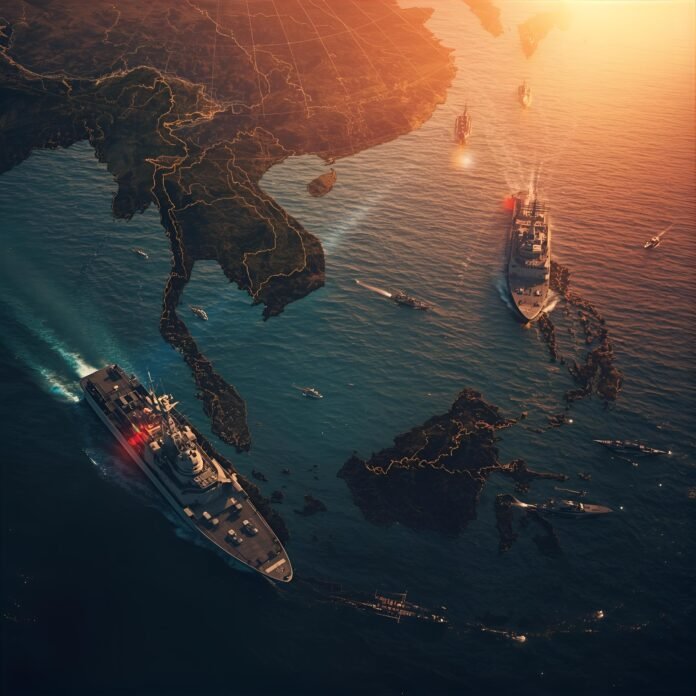
On a map, the Indian Ocean looks like open water; in practice, it’s a web of ports, loans, and quiet bargains. Over the last decade, Chinese military and naval presence in the Indian Ocean has grown steadily, which indicates increasing strategic aspirations in this area. Since 2008, Beijing has sent more than 45 naval missions to the Indian Ocean Region (IOR) and at any given time there are up to 10 Chinese warships along with auxiliary craft and hydrographic survey vessels able to stay for long periods in these waters. The People’s Liberation Army Navy (PLAN) has more than 370 high-tech ships and three aircraft carriers in service. These monthly deployments and sightings of increased naval activity in the region suggest China’s ambition to become a blue-water navy through a long-term strategy to secure its own economic interests. In such a scenario the Indian response should call for a shift from a more defensive approach to proactive maritime diplomacy.
Naval operations are not the only maritime activity conducted by China; in 2024 and early 2025, the Chinese navy held multiple military exercises, which allowed them to operate in strategic waters, including the Arabian Sea, Gulf of Oman, Malacca Strait, Mozambique Channel, the Red Sea, and more. These waters effectively allow the Chinese to operate in important portions of their trade route, especially for oil. China has also taken steps to deepen relationships with countries neighbouring India that includes signing a security agreement with Maldives, sending a military delegation to Sri Lanka to assist with advancing bilateral security cooperation, and conducting their first-ever joint military exercise with Bangladesh.
These actions represent a clear attempt to not only establish reach, but exert great influence. It would be unwise to categorise these as isolated gestures, because they very pointedly drive the larger goal of reshaping China’s regional security architecture. They contribute to the “open sea protection” strategy, which emphasizes a broader shift in foreign policy goals in the oceanic region that challenges India’s historical influence in the IOR, outlined by the 2015 Defence White Paper. By expanding its military and diplomatic operations, China is signalling its ambition to alter the strategic balance in the region.
China’s Indian Ocean Expansion: Strategic Encirclement
While Beijing frames its activities in the region as mere economic expansion for trade and connectivity, India perceives these moves to be long term regional encirclement represented by the “String of Pearls” strategy, which refers to the network of Chinese-funded ports and infrastructure projects that stretch from the South China Sea to Port Sudan. These include Gwadar in Pakistan, Hambantota in Sri Lanka, Kyaukpyu in Myanmar, and several points in East Africa, each signifying a ‘pearl’ to enhance China’s ability to refuel, resupply, and possibly deploy naval forces in a crisis and fund projects to decrease India’s maritime sphere of influence.
For Beijing, it clearly displays long-term geopolitical foresight by establishing economic and security nodes, without the need for overt militarisation, to tilt the naval balance in its favour. By engaging regional states with economic incentives, it has easily been able to expand its influence while creating a potential framework where ports act as both trade facilitators and security assets without triggering immediate confrontation. It has created political dependencies, which pose serious risks to the long-established bilateral leverage that India holds in the region by indirectly restricting the country’s freedom of movement in its own backyard.
The Belt and Road Initiative further lends weight to this theory since most of India’s neighbouring states, such as Pakistan, Bangladesh, Nepal, Sri Lanka, and the Maldives, are BRI participants. This will allow China to surround India through a series of calculated infrastructure developments of a Road in the North and a Belt in the South. While framed as connectivity, India sees the BRI as creating dependencies that translate into tactical leverage.
China also remains the largest arms supplier to Pakistan. More than 80% of Pakistan’s recent military imports have come from Beijing. It was reported that Pakistan used Chinese supplied missile jets in the recent standoff between against India, arguably tipping the balance of airborne might. These deals could soon include hypersonic missiles and advanced naval weapons, strengthening China’s indirect military reach near India’s western coastline.
Beijing’s influence over the Strait of Hormuz through diplomacy as well as port access from Gwadar and Djibouti help offset the vulnerabilities in its energy supply chain that is considered China’s “Malacca Trap.” This encirclement over India’s strategic points extends into hydro-politics with China’s plan for mega dams on the Brahmaputra River. It claims that this move will support its carbon neutrality goals; however, at the same time, the river’s unique topography and the Great Bend allows for China to gain control over upstream water flow into India’s northeast, further inflaming territorial disputes with India. Though this does seem to be similar to India’s recent actions of suspending the Indus water treaty with Pakistan to limit the river’s flow into the neighbouring country.
For China, control over the Brahmaputra’s flow showcases geopolitical bargaining that extends well beyond hydropower, especially in north-eastern zones where ethnic tensions already make the regions fragile. While India’s actions to suspend their treaty is justified as a response to terrorism, it also highlights a shift from the country’s usual water diplomacy rooted in the long-standing cooperation. The symmetry in these strategies seem to suggest a popular trend of using natural resources as exploitation tools for exerting pressure. This suggests a future of weak regional water-sharing frameworks, and destabilized environmental and humanitarian systems across South Asia. It signifies that the India-China rivalry is no longer limited to borders; it’s flowing into rivers and oceans alike.
In view of this, hydro-politics may not just reflect rising tensions, but actively shape the trajectory of future confrontations.
Ports, Debt, and Strategic Entrenchment in the Indian Ocean
One way to understand China’s port strategy in the region is to observe how it uses ports and debt together. It hinges on a model of debt-financed infrastructure that often has limited public disclosure and weighs in Beijing’s favour. Firstly, it offers concessional loans for large-scale projects, and when the country struggles to repay, it converts those loans into long-term leases of strategic ports for operational control. One of the most well-known examples of this is Sri Lanka’s Hambantota port, which is now leased to China for 99 years after its recent debt crisis. A similar pattern can be observed in deals that now have Pakistan’s Gwadar port andMyanmar’s Kyaukpyu Port leased to China. Another example is Djibouti, where China holds more than 70% of the country’s total external debt.
These ports not only provide access for regular trade activities but also offer military potential. Many have deep-water docks and secure storage that could support warships. Just recently, the docking of Chinese vessels at Hambantota for ‘research’ purposes raised concern due to their suspected surveillance missions, which were reportedly denied by Beijing. Alarmingly, China now operates at least 13 ports in the IOR. From New Delhi’s perspective, these hold the power of disrupting the regional naval parity and spying on its naval infrastructure.
Hence, using ports as permanent fixtures of influence, loans as tools of leverage, and economic projects as veiled strategic assets suggests an attempt of clear deliberate entrenchment. As China embeds itself more deeply through debt and development, it becomes harder for India to push back. Together, they make it difficult for India to dislodge Chinese presence once established.
Smaller Indian Ocean States Are Strategic Players
All of this growing infrastructure relies on cooperation with host nations. In this era of maritime politics, smaller island states have emerged as strategic players. As China builds influence and India attempts to push back, countries like Sri Lanka, Myanmar, Maldives and Seychelles find themselves in the middle of a tactical contest.
India has promptly responded to China’s actions by undertaking a series of projects in the neighbouring island states as well. These include construction of a jetty and an airstrip, as well as six other developmental projectson Agalega Island in Mauritius. In Myanmar, India has secured a lease for the Sittwe Port, which will be renewed every three years for further infrastructural activities. The country has pledged over 4 billion dollars in aid to Sri Lanka for its economic crisis. These signal India’s attempt to counter China’s port diplomacy.
However, these actions, when compared to China’s efforts, seem modest in scale and impact. While China provides long-term leases and massive infrastructural help using substantial resources and investment, India’s diplomacy seems to still lag behind and gives the impression of a more defensive approach, especially in the wake of political sensitivities, which hampers its progress. Sri Lanka and the Maldives have witnessed recent political turmoil, which has reinitiated anti-India rhetoric, resulting in the retrenchment or termination of several Indian-guided efforts. In Seychelles, the planned establishment of a defence base on Assomption Island has been shelved over environmental and sovereignty issues.
This difficulty shows the fragility of India’s influence even after years of investment.
On the other hand, China’s ability to offer loans at a more attractive rate continues to deepen Sri Lanka’s dependence on China. It has begun massively expanding its investment in other island nations, offering security cooperation as well as infrastructural development. In the broader context of China’s rising naval presence and its entrenchment through debt and ports, these countries have become essential pieces of a regional puzzle that is still being assembled. To shift this balance, New Delhi will have to evolve beyond just transactional assistance and work towards a forward-looking comprehensive vision that combines development, defence and diplomacy.
These island states are now becoming strategic diplomatic players by extracting commitments from both nations while keeping their sovereignty intact. Their role as logistical key points in the region makes them vital in the current atmosphere.
India’s Counterstrategy: From Maritime Balancing to Strategic Engagement
Faced with growing Chinese influence, India’s counterstrategy has moved from quiet monitoring to active maritime balancing. The SAGAR doctrine which is short for “Security and Growth for All in the Region,” marks a major turn, promoting India as a “net security provider” in the region. In contrast to China’s Belt and Road Initiative (BRI), SAGAR emphasizes capacity building, economic development and maritime security. While China’s model has been effective in creating physical infrastructure and logical hubs, India’s approach is more grounded in trust-based partnerships for development. It consolidates the idea of the “Indo-Pacific” in India’s strategic outlook.
This is reflected by increased submarine acquisitions and rising naval spending. The INS Vikrant is India’s first indigenous aircraft carrier in service since September 2022, while the Defence Acquisition Council has approved production of six diesel-electric submarines as well as three more Kalvari-class submarines. The development of a new naval base at Minicoy Island in Lakshadweep brings India closer to the Maldives, especially in light of the growing proximity of the country with China. This suggests a shift of attitude from “sea control to sea denial” by denying access to key zones.
India is conducting naval exercises such as MILAN and Malabar with the US and Japan while entering bilateral agreements with countries such as Mauritius, Seychelles, and Oman. SAGAR projects India as a net security provider, with efforts ranging from humanitarian assistance and disaster relief to joint naval exercises. It offers a more inclusive and sustainable model of regional engagement.
However, India faces obstacles in certain crucial aspects. China benefits from being able to rapidly mobilize funds to execute large-scale infrastructure projects. Moreover, Chinese Navy far exceeds that of India in terms of hardware, fleet size and deployment capacity. India, with its ever growing ambition, remains challenged by budgetary limits, competing priorities and bureaucratic delays.
But India is actively investing in alternate trade routes. A total of Rs. 400 crores have been allocated for the development of the strategic Chabahar Port in Iran as part of its investment in the International North-South Transport Corridor (INSTC), creating an alternative trade route bypassing the Chinese-controlled ports in the region. India also unveiled the India-Middle-East-Europe Economic Corridor(IMEC) as a counter to the Belt and Road Initiative. While these initiatives reflect a strategic vision, their viability remains questionable. INSTC, despite its potential, is still underutilised and lacks the streamlined infrastructure that gives BRI its appeal.
IMEC faces the challenge of sustained multilateral cooperation in the current geopolitical climate. Iran, has repeatedly shown a willingness to block maritime traffic through the strategy of blocking strategic nodes. With rising tensions between Iran and Israel, this could lead to reduced participation by other Middle East allies, and lead to geopolitical fragmentation. A recent example of this would be the Red Sea Crisis, during which India, despite retaining a neutral stance, was drawn into the conflict by Houthis, when they attacked Indian commercial ships passing through the region. This revealed that India needs more than neutrality, it needs reliable partners and corridors.
With Iran now declaring its intention to close the Strait of Hormuz due to US aggression, even projects like Chabahar are faced delays and implementation challenges. Therefore, while these alternate routes are symbolically important and offer a consistent vision for the future, they don’t rival the scale or speed of BRI. New Delhi’s diplomacy stands at a crossroads. A decision needs to be made by India between deepening its relationship with Tehran to secure trade access or allowing a stronger affinity towards Israel and the West.
Iran, Maritime Chokepoints, and the Strategic Undercurrents of China’s Indian Ocean Presence
China’s edge in the Indian Ocean is not built on hulls alone. It is made of relationships: patiently assembled ties that travel with its ships. During the Red Sea disruptions, Beijing’s quiet capital with Tehran and Iran-aligned actors helped keep Chinese-flagged traffic largely out of the line of fire, allowing trade to keep moving while others rerouted.
This brings us to the current scenario. The recent military strikes by the US to destroy Iran’s nuclear bases and Iran’s retaliatory attacks on US bases in Qatar and Iraq threaten to destabilize an already contentious Middle East, which could lead to the closing of the Strait of Hormuz, affecting nearly 20% of the world’s trade.
In the past, Chinese ships were not attacked due to the Iranian influence on the Houthis, which may prompt China to leverage its influence over Iran on this decision. This way, the country ensures that its energy supply chains remain protected even in case of a crisis. China benefits from a stable Middle East due to its extensive investments in trade and infrastructural development in Iran, which could be jeopardized in the event of a regime change influenced by U.S. intervention. The Strait of Hormuz forms a critical node for China in its “String of Pearls” network to sustain dominance and uninterrupted access in the IOR.
India, meanwhile, is still threading a middle course but this balancing act is growing harder. One path runs through Chabahar and the International North–South Transport Corridor—an end-run around Chinese-shaped nodes that depends on steady ties with Iran. The other leans into Western alignment: technology sharing, maritime domain awareness, and tighter cooperation in the Indo-Pacific. Each comes with costs. Closer work with Tehran invites exposure to American tariffs or secondary-sanctions pressure; deeper alignment with Washington can bring market access and kit, but on terms that may demand trade concessions and political bandwidth Delhi doesn’t always have. Push too hard on tariffs or penalties, and India edges back toward hedging with Iran and, by extension, Russia.
As geopolitical alignments shift, a contrast in strategy might make India more susceptible to tensions. As China plays the long game by investing in diplomacy and debt, India needs to become increasingly assertive.
Going forward, India’s challenge will be to convert its growing capabilities into a stable order. The ability to defend its sea routes, partners, and influence outcomes, especially in the case of hostility between nations, will determine whether it can shape the future maritime order or always be on the defence.
Conclusion
India and China are standing at a crucial point in 21st century maritime politics. China’s debt diplomacy, port entrenchment of key points like Gwadar, Djibouti, and Port Sudan constitute a strategy of encirclement aimed at establishing dominance in the IOR. On the other hand, India is investing in new trade routes, building its domestic naval capabilities, and exploring agreements with other nations in exchange for security.
Key points such as the Strait of Hormuz indicate how quickly even the slightest tension can escalate into long term global trade disruption. India’s dilemma in the Israel-Palestine conflict, as well as its relationship with Iran, represents the need for smart diplomacy to overcome friction points and gain commercially from the crisis. Meanwhile, China’s already-established relationships allow it to avoid entanglement while maintaining trade flows.
In this new security environment, small island states are not bystanders but rather important points of leverage. The long-term shaping of the IOR will depend on how China and India negotiate their competition, avoid militarized rivalry, and reconcile aspirations for trade with regional stability. It seems imperative that this is no longer just a contest about trade routes; it is a contest to define the rules of dominance at sea for decades to come.
If India doesn’t anchor its ambition soon, it may find itself sailing in waters chartered by China.


